
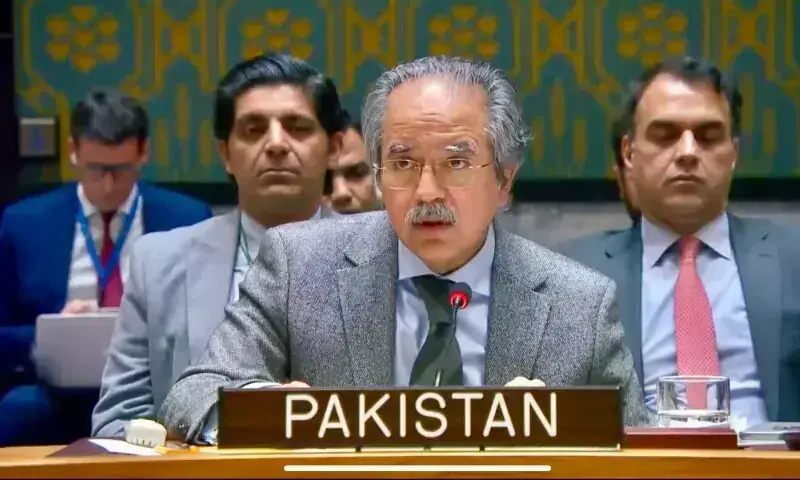

UNITED NATIONS, Feb 05: Pakistan’s permanent representative to the UN, Ambassador Asim Iftikhar Ahmad, implored the UN Security Council to quickly designate the Balochistan Liberation Army (BLA) as a terrorist group under the sanctions regime established by Resolution 1267 in 1999. This call to action underlines Pakistan’s commitment to confronting and eliminating terrorism within its borders.
During a Council debate on ‘Threats to International Peace and Security Caused by Terrorist Acts,’ Ambassador Ahmad highlighted that groups like Fitna al Khawarij (TTP) and the BLA have gained a “new lease of life” following the Taliban’s control in Kabul. The United States has already identified BLA as a “foreign terrorist” organization.
The ambassador expressed hope for a swift response from the Security Council to designate the BLA under the 1267 sanctions regime, noting that the listing request is under current consideration.
He emphasized the need for a “collective, comprehensive, and coordinated response” from the international community to combat modern terrorism threats. He pointed out that terrorist groups such as BLA and TTP operate with impunity from Afghan soil, citing “active support from our eastern neighbor,” which has been linked to severe attacks inside Pakistan.
The Council’s Monitoring Team has documented that Afghanistan provides a permissive environment for various terrorist groups. Al-Qaeda, ISIL-K (Da’esh), and ETIM/TIP members move freely in Afghanistan, posing a regional and global threat.
This weekend, BLA claimed responsibility for terrorist attacks in Balochistan, resulting in the deaths of 48 civilians, including 5 women and 3 children. In response, 145 BLA militants were neutralized by Pakistani security forces.
Ambassador Ahmad underscored the need for accountability of external actors who finance and support terrorism, stressing that “state terrorism” must not be tolerated. He called for recognition of the struggles against foreign occupation and emphasized the importance of addressing root causes of terrorism.
In the debate’s opening remarks, Alexandre Zouev, Acting Under-Secretary-General of the UN Office of Counter-Terrorism, presented the Secretary-General’s report on the threat of ISIL/Da’esh. He highlighted the group’s resilience and the need for global cooperation against terrorism, with particular concerns in Africa, Iraq, Syria, and Afghanistan.