

ISLAMABAD, Jan 30: Speakers at a United Nations Security Council meeting, held under the Arria-Formula format, underscored the core principle of ‘pacta sunt servanda’ — the necessity to honor agreements to sustain global stability and uphold international law. The discussion focused on India’s unilateral decision to withhold the 1960 Indus Waters Treaty (IWT) with Pakistan, drawing significant attention.
The representatives at the 15-member meeting reaffirmed the legally binding nature of treaties under international law. This session, convened by Pakistan, was widely acknowledged as timely and significant, occurring amidst a complex political scenario.
Arria-Formula meetings, named after a former Venezuelan UN ambassador, provide an informal setting for Security Council members to engage in open and private exchanges on relevant topics.
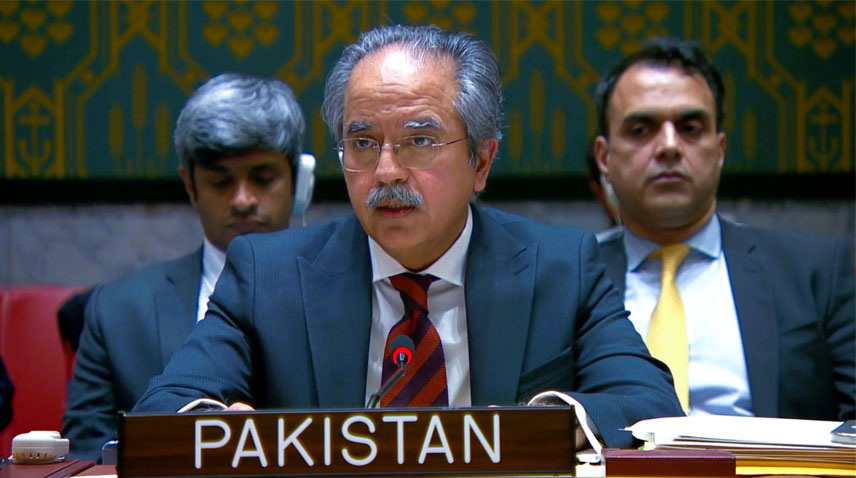
Friday’s session focused on “Upholding the Sanctity of Treaties for the Maintenance of International Peace and Security”.
Presided over by Pakistan’s UN Ambassador Asim Iftikhar Ahmad, the meeting included participation from over 40 delegations and experts.
“Treaties are not ceremonial texts,” stated the Pakistani envoy at the debate’s outset, emphasizing, “They are the operating system of peaceful international relations.”
Ambassador Asim Ahmad highlighted the immediate risks posed when vital resources, such as water, are placed at the unilateral discretion of states. This particular context referred to the potential adverse effects of interrupted water flows on downstream populations.
He noted that the International Court of Justice has consistently recognized that ‘good faith is one of the basic principles governing the creation and fulfillment of legal obligations’, stressing that disputes must be resolved through agreed legal mechanisms, rather than unilateral actions.
“We are witnessing a troubling pattern,” he noted, with treaty commitments increasingly facing selective interpretation, delays in implementation, suspension, or unilateral decisions to hold them in abeyance.
The envoy warned, “Legal uncertainty translates into political risk; political risk becomes a security threat,” pointing to the erosion of treaties leading to strategic ambiguity.
He added, “Preventive diplomacy is weakened, regional tensions escalate, and unresolved political disputes in sensitive areas become more volatile.”
Regarding the Indus Waters Treaty, Ambassador Ahmad remarked that it is considered one of the most resilient water-sharing agreements globally.
“For over six decades, it has endured wars, crises, and intense political tensions between India and Pakistan, including the longstanding Jammu and Kashmir dispute,