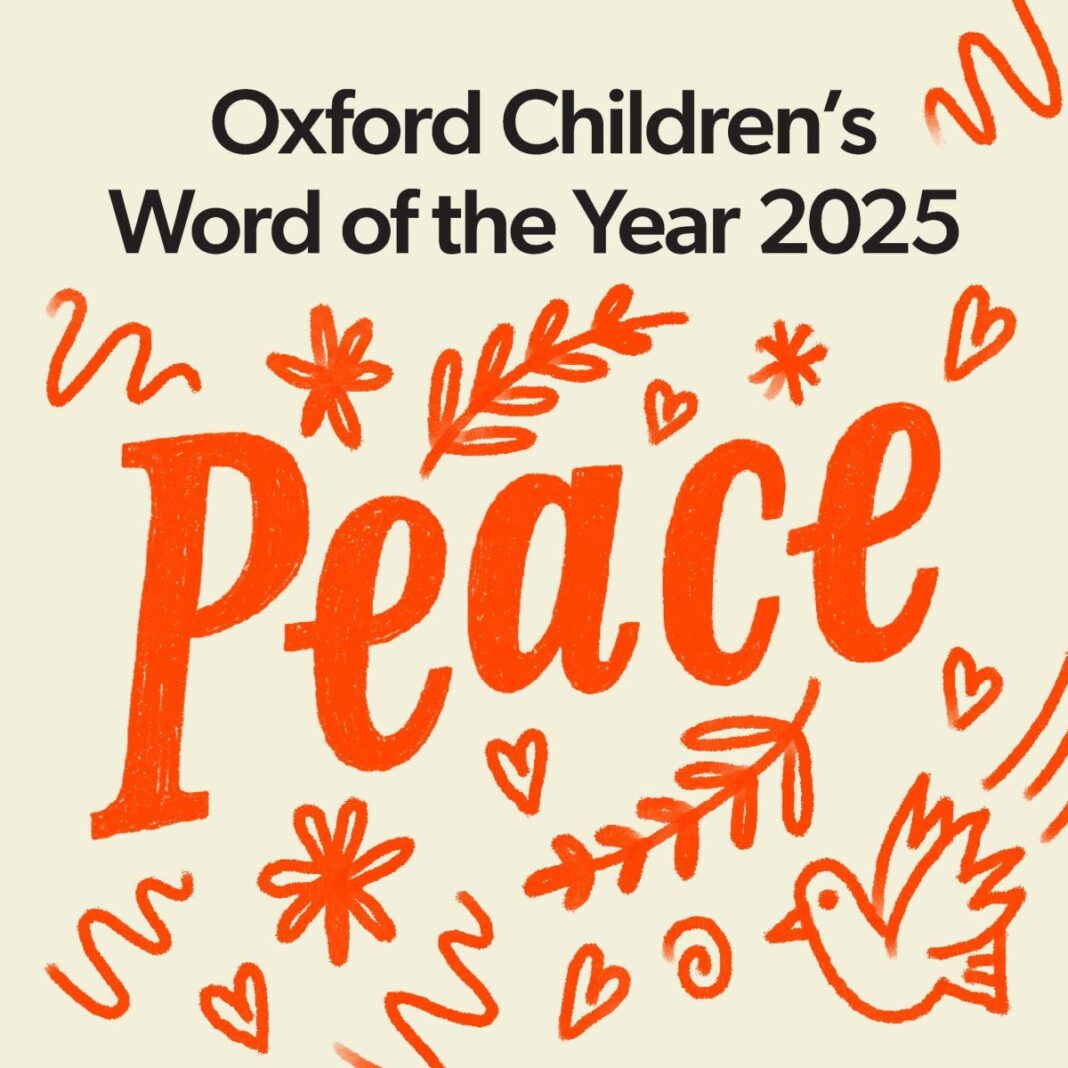

ISLAMABAD, Jan 28: According to research by Oxford University Press (OUP), ‘Peace’ has been chosen as Oxford Children’s Word of the Year for 2025. This was selected by 35% of children, closely followed by 33% who selected ‘AI’ and 21% who chose ‘resilience’.
The study, conducted in 2025, involved nearly 5,000 children across the UK, aged 6–14, and emphasized their awareness of current affairs. A press release noted that one out of ten children mentioned ‘war’ as a reason for choosing ‘peace’ and referenced specific conflicts such as ‘Ukraine’ and ‘Gaza’.
Children often used words like ‘need’, ‘want’, and ‘should’ in their responses calling for global peace.
An analysis of the Oxford Children’s Corpus, the world’s largest database of child-focused English writing exceeding half a billion words, showed a 60% increase in ‘peace’ mentions in children’s stories submitted to the BBC 500 Words competition since 2015.
For the second year in a row, AI was a close runner-up. One-fifth of children cited ‘hearing’ and ‘talking’ about AI, highlighting its prevalence in everyday life.
When asked about their feelings toward AI, children responded positively, with over one in ten describing it as ‘excited’ or ‘exciting’. The word ‘AI’ was chosen by 29% of children aged six to eight, indicating early awareness of AI’s role in daily life.
Almost half of the children (47%) picked ‘six-seven’ as their slang of the year, followed by ‘aura’ (24%) and ‘delulu’ (7%). The findings suggest ‘six-seven’ fosters inclusivity and social connection, with children associating it with ‘friends’, ‘popular’, and ‘fun’.
Although 12% admitted not knowing its meaning, 72% of participants acknowledged the importance of having words exclusive to their friend groups.
OUP encourages schools to participate in the next Word of the Year initiative, enhancing children’s reading, vocabulary, and speaking skills.
Schools are urged to engage in ‘word of the year’ discussions throughout the school year and choose their word for 2026. OUP has created an activity pack to aid participation, offering ways to foster book discussions and language development. Details for downloading the pack and involvement are provided.
To coincide with the announcement and support the 2026 National Year of Reading, OUP will collaborate with the National Literacy Trust on UK-wide school events. Author-led events are designed to engage children with various reading types and encourage reflection on the words they read, hear, and learn.
Andrea Quincey, Director of Early Years and Primary Publishing at OUP, stated: “Our research shows children’s keen awareness of current events, whether calling for peace or recognizing AI’s daily impact. Unsurprisingly, ‘six-seven’ is overwhelmingly voted the slang word of the year, offering joy and connection. We see the value in kids having language autonomy and sharing words adults may not understand.”
Quincey continued, “We request schools join our 2026 research, aiming to capture regional colloquialisms and hear from more children. These findings underscore the significance of ongoing studies into children’s language for supporting their expressive capabilities.”
Jonathan Douglas CBE, National Literacy Trust Chief Executive, commented: “Language shapes our society and identity. Understanding how young individuals interpret, adopt, and play with words highlights language’s power in understanding our world and our place in it.”
Douglas emphasized that the National Year of Reading will offer new opportunities for young individuals to experience language in enjoyable, relevant ways, connecting them with others. The partnership with OUP and respected authors will bring the wonder of reading to children across the UK.
Experts and researchers at OUP have been monitoring Children’s Word of the Year for more than a decade, analyzing language evolution and its emotional reflections. In response to recent findings, OUP’s Children’s Language department released the Oxford Children’s Word of the Year 2025 report, which went live on January 21, 2026.