
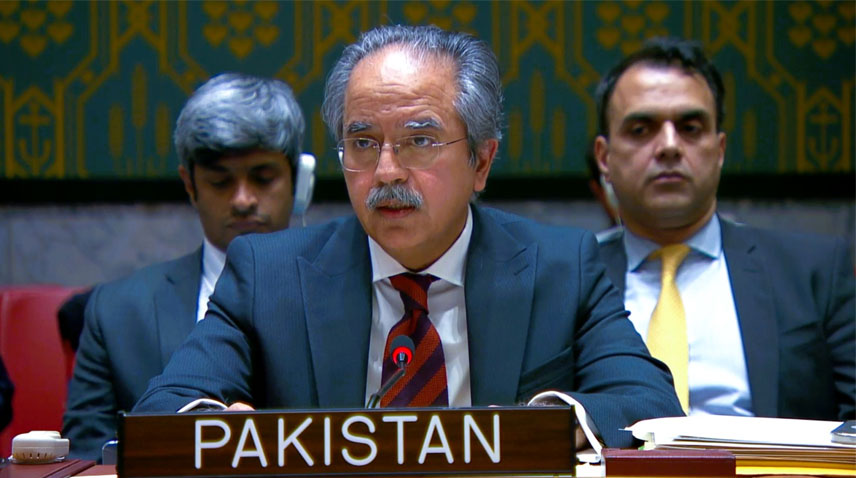

At a United Nations Security Council meeting held under the Arria-Formula format, speakers stressed the importance of the principle ‘pacta sunt servanda,’ or ‘agreements must be honored,’ to ensure global stability and adherence to international law. During this meeting, Pakistan highlighted India’s unilateral decision to suspend the 1960 Indus Waters Treaty between the two countries.
The meeting, attended by the 15-member Security Council and led by Pakistan’s UN Ambassador Asim Iftikhar Ahmad, reaffirmed that international treaties are binding. The session, which saw participation from over 40 delegations and experts, was collectively recognized as timely and crucial given the current complex political atmosphere.
Arria-Formula meetings, named after a former Venezuelan UN ambassador, allow Security Council members to discuss subjects informally and privately. This session’s topic emphasized ‘Upholding the Sanctity of Treaties for International Peace and Security.’
Ambassador Ahmad opened the debate by asserting that treaties are not merely ceremonial; they form the foundation of peaceful international relations. He cautioned that when millions’ livelihoods are subjected to unilateral decisions, the dangers are immediate and tangible.
Ambassador Ahmad referenced the International Court of Justice’s position that ‘good faith’ plays a crucial role in forming and executing legal obligations, noting that disputes should be resolved through agreed legal frameworks, not unilateral acts that disturb the balance of rights and obligations.
Highlighting the challenges facing treaty adherence, Ambassador Ahmad pointed out that selective interpretation, delayed implementation, and unilateral actions create legal uncertainty that transforms political and security risks.
With respect to the Indus Waters Treaty, the Ambassador noted its reputation as a resilient water-sharing agreement that has endured wars, crises, and political tensions between India and Pakistan over the past six decades. He warned that India’s current actions represent a significant departure from the established legal framework, posing risks to Pakistan’s downstream population of 250 million.
In August 2025, the Court of Arbitration confirmed the treaty’s validity and its binding dispute-resolution mechanisms, stating that no party has the right to suspend or nullify the agreement unilaterally.
Ambassador Ahmad emphasized that this situation is not just a bilateral issue but a test case for the global system. If such binding agreements on shared natural resources can be overturned unilaterally, no treaty is safe from geopolitical pressures.
He concluded by underscoring the Security Council’s role in crisis prevention, advocating for treaty compliance as a strategic necessity for both conflict prevention and resolution. “The clear and collective message should be that treaties should not fall victim to geopolitics. They remain vital for restraint, cooperation, and peace,” he said.