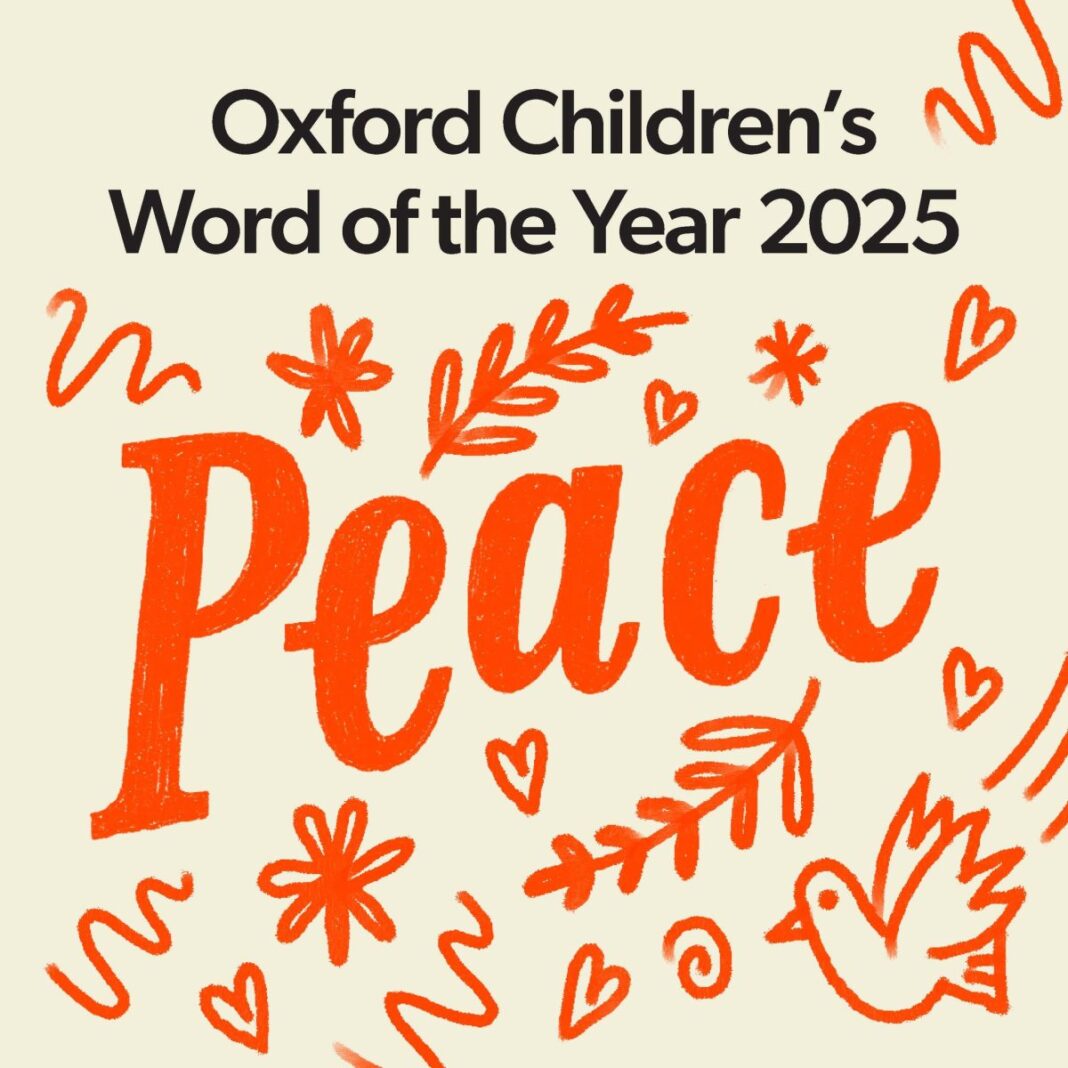

ISLAMABAD, Jan 28: According to a study by Oxford University Press (OUP), ‘Peace’ has been chosen as the Oxford Children’s Word of the Year for 2025. This selection comes from 35 percent of children surveyed, closely followed by 33 percent selecting AI, and 21 percent opting for resilience.
Conducted in 2025, the research surveyed almost 5,000 children in the UK aged 6–14, highlighting their awareness of current affairs.
When asked why they chose ‘peace’, one in ten children mentioned ‘war’, citing specific conflicts like ‘Ukraine’ and ‘Gaza’. Words such as ‘need’, ‘want’, and ‘should’ were common in their responses, underscoring a desire for global peace.
A study of the Oxford Children’s Corpus, the largest database of children’s writing in English, revealed references to peace in stories submitted to the BBC 500 Words competition have surged by 60 percent since 2015.
For the second year running, AI was the runner-up. A fifth of children mentioned they heard and talked about AI, indicating its pervasive presence in daily life.
Children expressed positive feelings towards AI, with over ten percent describing it as ‘exciting’. Notably, 29% of children aged six to eight named AI as their word of the year, reflecting its influence on the younger demographic.
Nearly half (47 percent) of the children chose ‘six-seven’ as their slang word of the year, followed by ‘aura’ (24 percent) and ‘delulu’ (7 percent). ‘Six-seven’ was associated with inclusivity and social ties, with ten percent associating it with ‘friends’ and 28 percent with ‘fun’ and ‘laughter’.
While 12% of children indicated ‘six-seven’ had no meaning, a majority highlighted the importance of having unique words shared among friends, with 72 percent affirming its significance.
OUP encourages schools to join the next Oxford Children’s Word of the Year initiative to enhance children’s reading, vocabulary, and conversational skills. Schools are invited to hold discussions and vote for their 2026 word choice. Resources, including an activity pack, are available to facilitate these discussions.
OUP is also collaborating with the National Literacy Trust for the National Year of Reading 2026, promoting author-led events to engage children in reading and reflecting on the words they encounter.
Andrea Quincey, Director of Early Years and Primary Publishing at OUP, notes how children are attuned to current events, whether calling for peace or recognizing AI’s impact.
She highlights ‘six-seven’ as a favored slang term, promoting joy and connection among children, and emphasizes the importance of capturing children’s colloquial language and regional voices.
Jonathan Douglas CBE, Chief Executive of the National Literacy Trust, remarks on the power of language in shaping culture and identity, stressing the significance of children engaging with language in meaningful and enjoyable ways.
For over a decade, OUP experts and researchers have tracked the evolution of children’s language. This year’s findings prompted the release of the Oxford Children’s Word of the Year 2025 report, published on January 21, 2026.