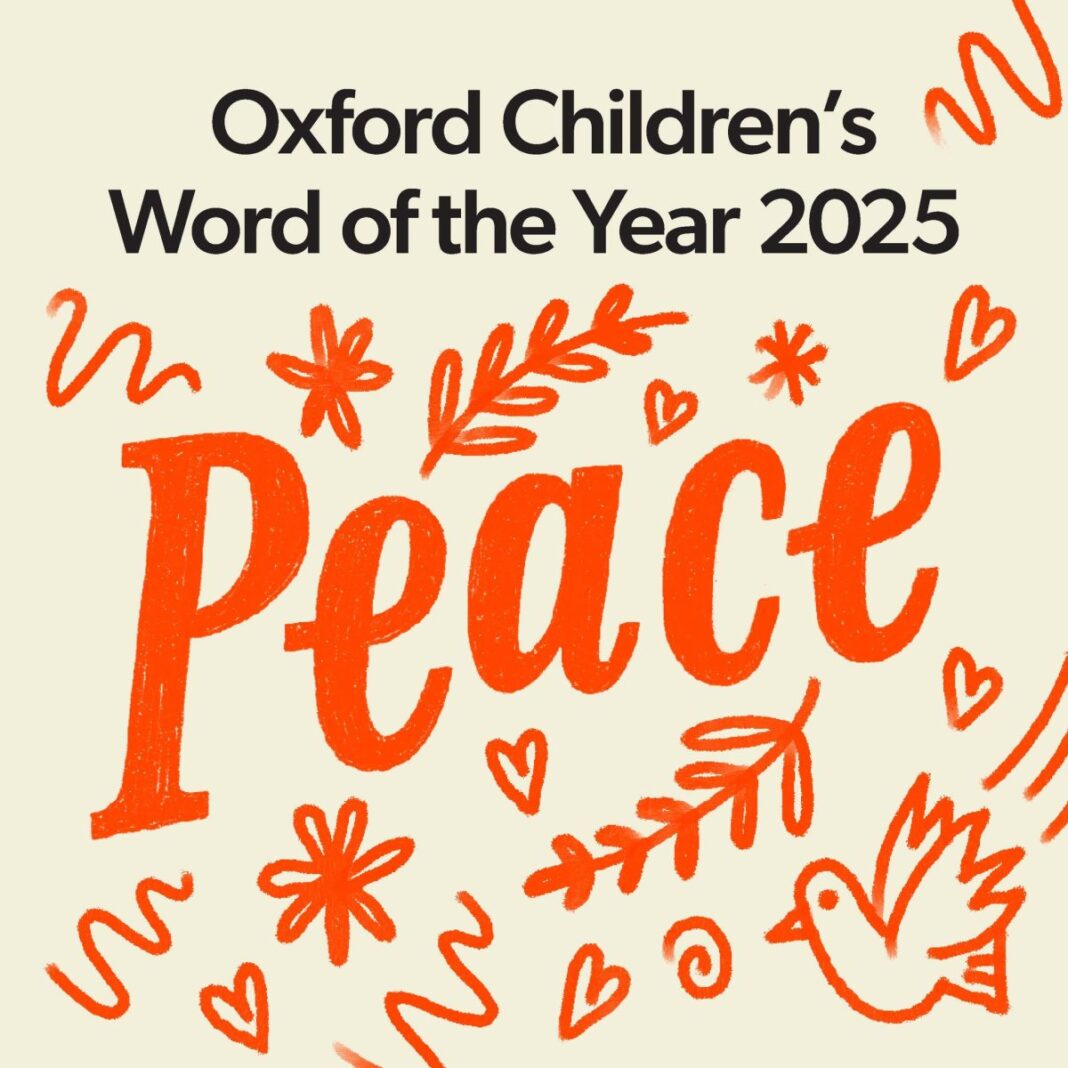

ISLAMABAD, January 28: Peace has been recognized as the Oxford Children’s Word of the Year for 2025, according to a study conducted by Oxford University Press (OUP). The research showed that 35 percent of children chose ‘peace’, closely followed by those who selected ‘AI’ at 33 percent, and ‘resilience’ at 21 percent.
Conducted in 2025, the study surveyed nearly 5,000 children aged 6–14 across the UK, highlighting their awareness of current world events, as stated in a press release.
A tenth of the children mentioned ‘war’ when explaining their choice, highlighting conflicts in areas such as ‘Ukraine’ and ‘Gaza’. Terms like ‘need’, ‘want’, and ‘should’ were commonly used in their responses advocating for global peace.
An examination of the Oxford Children’s Corpus, the largest database of children’s writing in English with over half a billion words, showed that mentions of peace in children’s stories submitted to the BBC 500 Words competition have surged by 60 percent since 2015.
For the second year running, AI was the runner-up, with 20 percent of children associating the term with frequent discussions and mentions of AI in everyday life. Many children expressed excitement towards AI, with over one in ten describing it as ‘exciting’. Approximately 29% of six- to eight-year-olds selected AI as their word of the year, demonstrating their early awareness of its role in daily life.
Nearly half of the children (47 percent) picked ‘six-seven’ as their slang word of the year, followed by ‘aura’ at 24 percent, and ‘delulu’ at 7 percent. The research suggests that using ‘six-seven’ promotes inclusiveness and social interaction, with many children linking it to friendships and citing it as ‘popular’ and ‘fun’.
Although 12% of children admitted that ‘six-seven’ carried no meaning for them, a majority valued such words, with 72% emphasizing the importance of having words used exclusively with friends.
OUP is encouraging schools to participate in the next Oxford Children’s Word of the Year to aid children in enhancing their reading, vocabulary, and speaking skills. Schools are urged to incorporate ‘word of the year’ discussions throughout the academic year and to vote for their choice for 2026. OUP has developed an activity pack with guidelines and resources for participation, including ways to promote book discussions and language development. Detailed information on how schools can obtain the pack and participate is available.
In celebration of this announcement and in support of the National Year of Reading 2026, OUP will collaborate with the National Literacy Trust on school events throughout the UK. These author-led events aim to motivate children to explore various reading forms and reflect on the language they encounter.
Andrea Quincey, Director of Early Years and Primary Publishing at OUP, stated, “Our research into the Oxford Children’s Word of the Year consistently demonstrates children’s awareness of current issues, whether it’s calling for peace in light of ongoing conflicts or emphasizing the everyday presence of AI.”
She added, “The overwhelming choice of ‘six-seven’ as their slang word highlights the laughter, joy, and connection it fosters. It underscores the importance of children having a unique language distinct from the adult world, enabling them to share words that adults might not grasp.”
Quincey further mentioned the push for schools to engage with the Oxford Children’s Word of the Year research for 2026, aiming to hear from more children and gather colloquial words, capturing regional insights. This ongoing study is crucial for understanding children’s language and supporting vocabulary development, as it’s vital for their self-expression.”
Jonathan Douglas CBE, Chief Executive of the National Literacy Trust, expressed, “Language plays a crucial role in shaping our society, culture, and identity. Understanding how children interpret and engage with words reinforces the significance of language in helping us make sense of our world.”
He remarked, “The National Year of Reading provides an opportunity to offer children and young people new and enjoyable experiences with language, connecting them with others. Throughout the year, we will partner with OUP and exceptional authors to bring the enchantment of reading and words to life for children and youth across the UK.”
For over a decade, experts and researchers at OUP have tracked the Children’s Word of the Year, analyzing the evolution of children’s language and its reflective capacity in expressing their emotions and experiences. In light of the recent findings, OUP’s Children’s Language department released the Oxford Children’s Word of the Year 2025 report, available since January 21, 2026.