

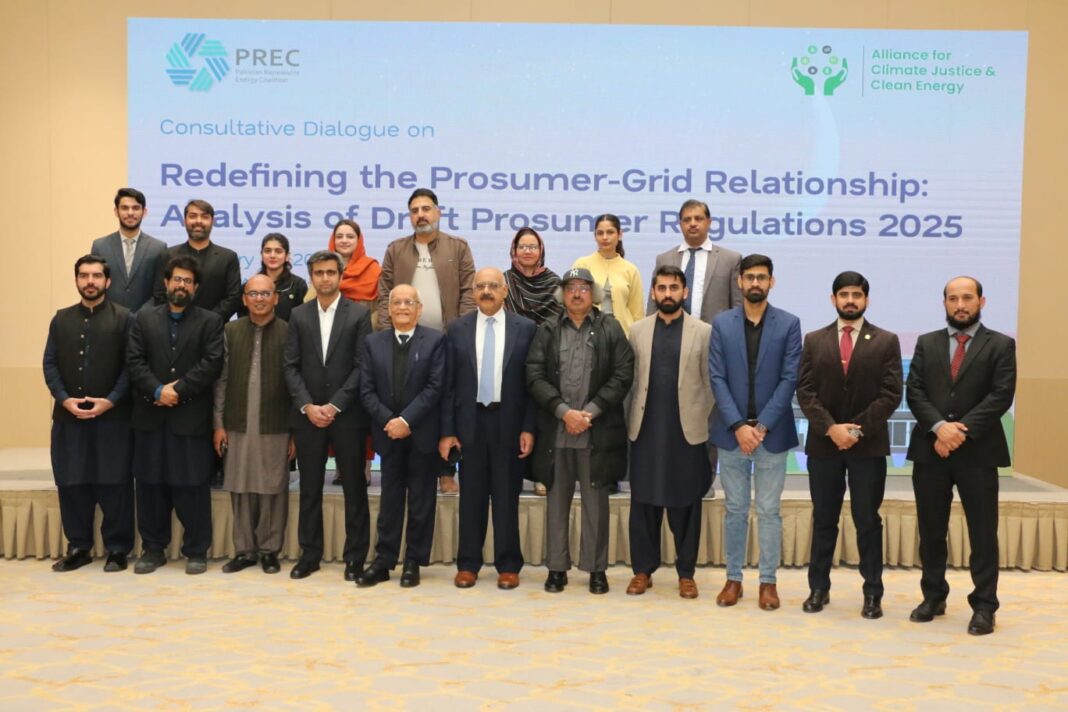

ISLAMABAD, Jan 28: Energy experts and key stakeholders warned on Wednesday that the proposed Prosumer Regulations 2025, amid Pakistan’s record-breaking rooftop solar expansion, could undo a decade of citizen-driven energy progress.
The concerns emerged during a national consultative dialogue titled “Redefining the Prosumer–Grid Relationship: Analysis of Draft Prosumer Regulations 2025,” jointly organized by the Pakistan Renewable Energy Coalition (PREC) and the Alliance for Climate Justice and Clean Energy (ACJCE).
Participants cautioned that shifting from net metering to net billing may destabilize the power sector, potentially leading consumers towards full grid defection.
Dr. Nafisa Shah, a Member of the National Assembly, stated, “Consumers are bearing the brunt of policy failures while simply trying to secure their basic right to electricity. The next phase of this revolution will be a battery rush, and we must safeguard those who rely on solar.”
Senator Dr. Zarqa Suharwardy Taimur emphasized that the proposed regulation contradicts ARE 2019, NDC 3.0, and the rights of solar consumers, adding, “It risks disincentivizing renewable energy adoption in a climate-affected nation.”
Experts highlighted that over the past decade, Pakistani citizens have independently imported over 51.5 GW of solar capacity. This organic growth, driven by high electricity prices and unreliable grid service, has transformed regular consumers into prosumers, who actively contribute to reducing peak demand and advancing the transition to clean energy without public funding.
Imtiaz Baloch, Director General Licensing at NEPRA, clarified, “This is still a proposal under consultation, not a policy change.” He noted legacy system constraints and emphasized the need for a forward-looking approach.
Zeeshan Ashfaq, CEO of Renewables First, pointed out that excessive administrative control has historically led to power sector failures, indicating that technological growth cannot be curtailed by administrative measures.
Dr. Khalid Waleed, Energy Economy Expert at SDPI, noted that the 2015 policy received global acclaim, whereas the 2025 draft opts for short-term fixes instead of long-term integration strategies. He suggested repurposing young coal plants like Sahiwal into ancillary service assets or converting them into Battery Energy Storage Systems (BESS) using sodium-ion technology.
Rabia Babar, Manager Data and Analytics at Renewables First, mentioned that grid electricity sales have declined for three consecutive years despite a rising number of consumers, indicating a shift away from grid dependency.
Former Managing Director of PPIB, Shah Jahan Mirza, stated that while the government may not aim to restrict solar growth, any transition should have been gradual and phased to prevent market disruption.